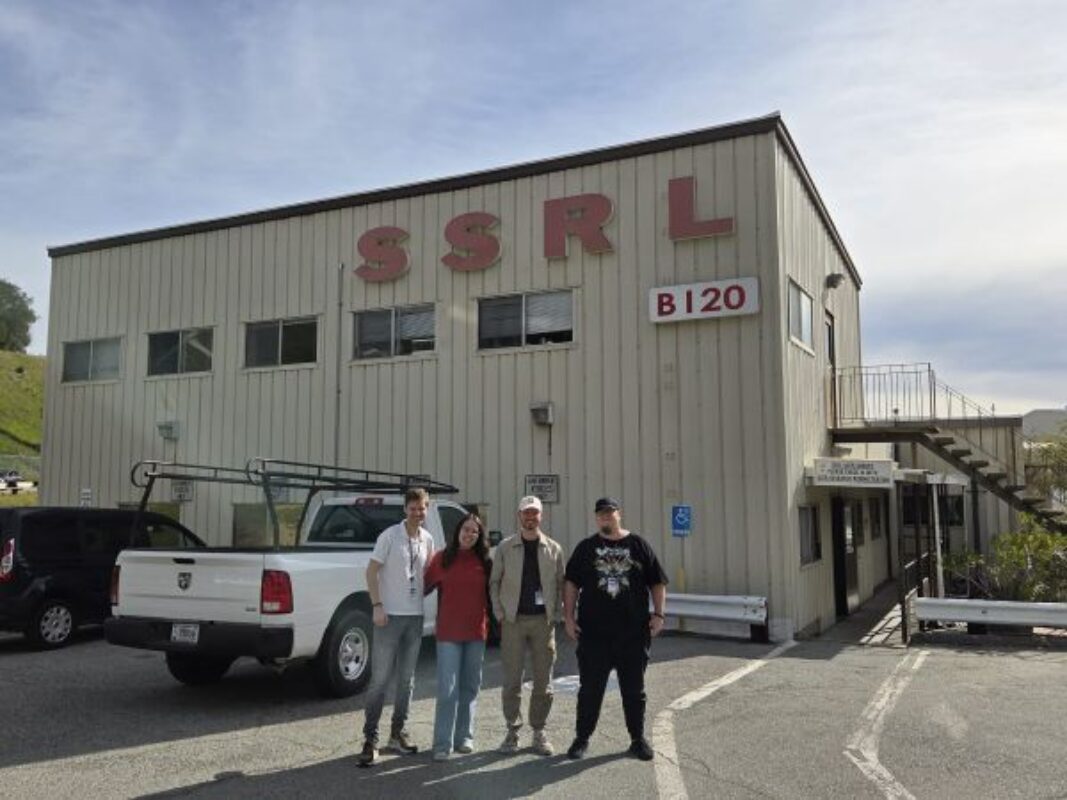
On February 3rd, around midday, we flew with the team to San Francisco. The team consisted of me, Bas den Hartigh (ARC CBBC), Robin Conradi (ARC CBBC), Ramon Oord (ARC CBBC) en Fleur Neijenhuis (ICC). Upon arrival in sunny California (21 °C and sunshine!) at San Francisco International Airport, we immediately drove south toward Menlo Park/Stanford, where SLAC National Accelerator Laboratory is located.
There, a synchrotron produces high-quality X-rays that can be used for spectroscopic techniques that are often not available in a regular laboratory. We used the technique “operando X-ray Absorption Spectroscopy (XAS)” to investigate a Co/TiO₂ catalyst used for the CO₂ hydrogenation reaction. With these experiments, we studied how the active phase of the catalyst — in this case cobalt — behaves under industrially relevant conditions, namely high pressure, and temperature (21 bar and 250 °C).
We had approximately 90 consecutive hours of beamtime for the experiments. To make optimal use of this time, we worked in two shifts: a day shift and a night shift. Fleur and I were in the day shift, Robin and Ramon in the night shift. Every morning and evening around 7:30 a.m. and 7:30 p.m., we relieved each other with a short handover, allowing the other two to get some sleep before starting another 12-hour shift the next day.
Of course, after all that hard work, we deserved some free time. We spent it sightseeing in the beautiful Bay Area and San Francisco. This naturally included visits to the Golden Gate Bridge, San Francisco itself, Alcatraz, and the stunning campus of Stanford University.
On the morning of February 13th, everyone returned to the Netherlands, marking the end of a successful “beam trip.” Now the long process of analyzing all the data begins (3 GB and more than 3000 spectra!).
Share this page


